Editor’s note: Updated July 2026: On July 13, 2026, the DoD suspended CMMC’s Phase 2 third-party assessment requirement and opened a 60-day program review. New solicitations still carry a DFARS 7025 provision — with Level 1 (Self) and Level 2 (Self) fill-ins — and active contracts with C3PAO designations are being amended. DFARS 7012 and NIST 800-171 obligations remain fully in force, and self-assessments in SPRS still carry False Claims Act exposure. We’ve updated this post to reflect the current state of 7025. See our full breakdown: CMMC Phase II is suspended. Here’s what changes for defense contractors.
TThe Department of Defense’s CMMC rule was incorporated into DFARS in November 2025 — and in July 2026, the DoD suspended its Phase 2 third-party assessment requirement pending a 60-day review. One provision matters through all of it: DFARS 252.204-7025, formally titled “Notice of Cybersecurity Maturity Model Certification Level Requirements.” It tells offerors what CMMC level a solicitation requires, it determines whether you’re eligible for award — and it’s where the suspension actually shows up in your contracts.
Unlike DFARS 252.204-7012 (which contains technical cybersecurity requirements) or DFARS 252.204-7021 (which governs ongoing compliance during contract performance), DFARS 252.204-7025 acts as a gatekeeper in solicitations. It alerts offerors to the CMMC level required before contract award. Miss the threshold, and you’re ineligible.
What Is DFARS 252.204-7025?
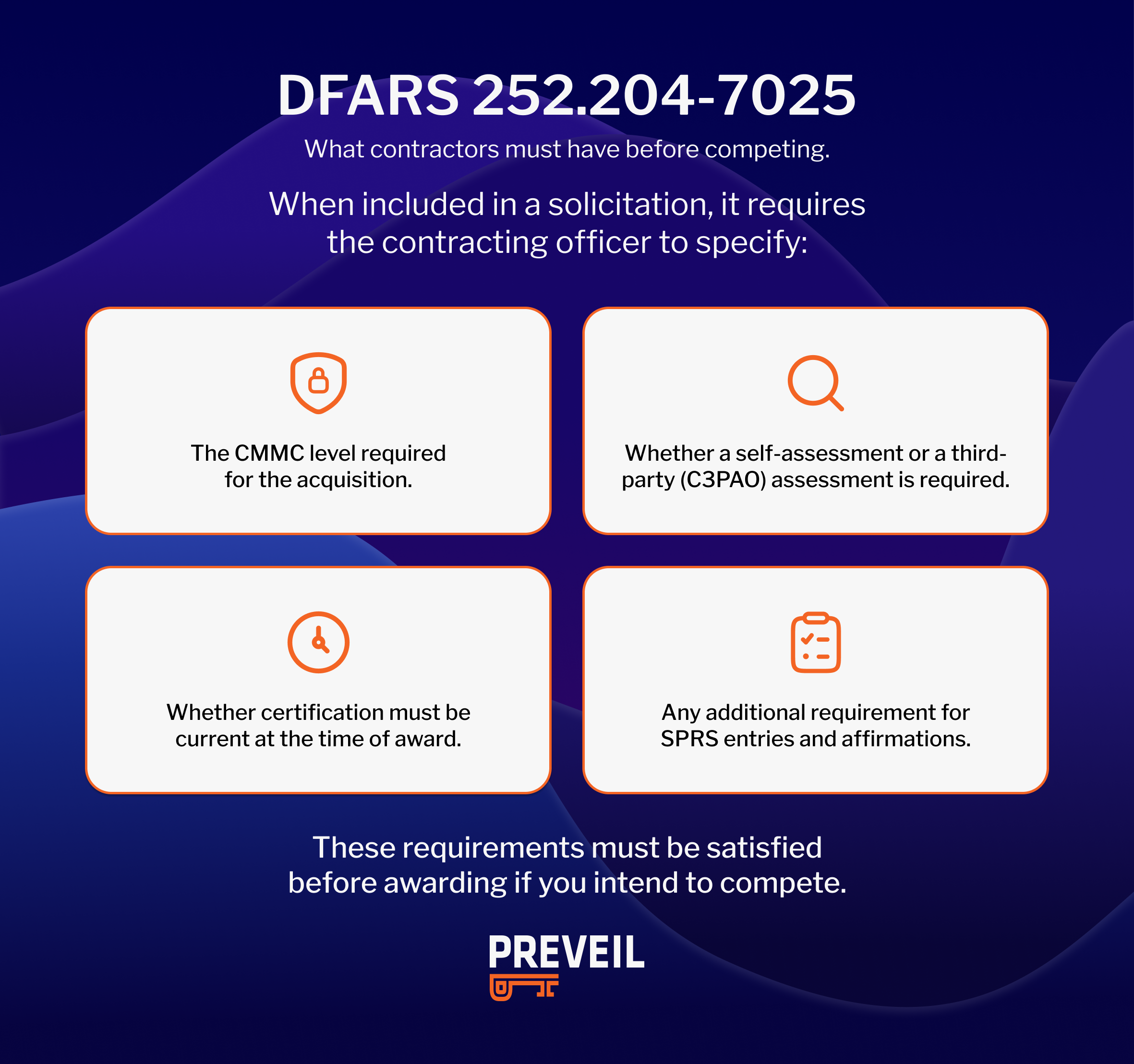
DFARS 252.204-7025 is a solicitation provision, not a contract clause. When included in a solicitation, it requires the contracting officer to specify:
- The CMMC level required for the acquisition: Level 1, Level 2 (Self or C3PAO) or Level 3.
- Whether a self-assessment or a third-party (C3PAO) assessment is required.
- Whether certification must be current at the time of award.
- Any additional requirement for SPRS entries and affirmations.
These requirements must be satisfied before awarding if you intend to compete.
The official text from the government’s notice on DFARS 252.204-7025 explicitly states:
“The CMMC level required by this solicitation is: ___ Contracting Officer insert: CMMC Level 1 (Self); CMMC Level 2 (Self); CMMC Level 2 (C3PAO); or CMMC Level 3 (DIBCAC). This CMMC level, or higher … is required prior to award …”
If an offeror lacks the specified certification or assessment status entered into the Supplier Performance Risk System (SPRS), the provision states they are not eligible for award.
What the July 2026 Suspension Changes for 7025
On July 13, 2026, the DoD suspended the Phase 2 requirement for third-party C3PAO assessments and opened a 60-day program review. For 7025 specifically, that means:
- New solicitations still include 7025. Contracting officers continue to insert the provision — but during the suspension, fill-ins specify Level 1 (Self) or Level 2 (Self). The eligibility gate hasn’t moved; what changed is which designations pass through it.
- C3PAO designations are coming out — but not automatically. Under a July 14 DoD memo, solicitations listing Level 2 (C3PAO) or Level 3 are being amended as soon as practicable; existing contracts will be modified at their next option period or scheduled administrative modification. Contact your contracting officer rather than assuming relief.
- Self-assessment obligations did not pause. Your SPRS score and affirmation remain live representations to the government, and the DOJ’s Civil Cyber-Fraud Initiative didn’t pause either. Knowingly misrepresenting compliance in a self-assessment carries the same False Claims Act exposure it did before July 13.
DFARS 252.204-7025 Explained
Solicitation Provision vs. Contract Clause
DFARS 252.204-7025 is invoked in the solicitation phase to inform bidders of the CMMC requirements they must meet to remain eligible. This is distinct from DFARS 252.204-7021, which governs performance of the contract and includes actual compliance requirements once the contract is awarded.
The rule requiring DFARS 252.204-7025’s use applies when a solicitation also includes DFARS 252.204-7021 and the acquisition will involve systems that process, store, or transmit Federal contract information (FCI) or Controlled Unclassified Information (CUI).
How DFARS 252.204-7025 Fits into the CMMC & DFARS Landscape
Understanding how 252.204-7025 interacts with related clauses will help contractors develop compliance and capture strategies.
- DFARS 252.204-7025 (Solicitation Provision)
Alerts bidders to the required CMMC level and assessment type needed before contract award. - DFARS 252.204-7021 (Contract Clause)
Inserted into the contract after award and governs the ongoing compliance with the specified CMMC level (including subcontractor flow-down obligations). - DFARS 252.204-7012
Contains NIST SP 800-171 cybersecurity controls and applies to CUI handling. CMMC Level 2 assessments map to these controls.
Together, these provisions shift cybersecurity compliance from a voluntary best practice to a binding eligibility and performance requirement in defense contracting.
What DFARS 252.204-7025 Means for CMMC and Your Business
1. Clear Award Eligibility Requirements
Once the provision is included in a solicitation, contracting officers can require proof of certification, self-assessment status, or SPRS entries before award. This means:
- Contractors must have the specified CMMC level ready and documented in SPRS.
- Self-assessments or C3PAO certifications and associated affirmations must be current.
Without meeting these conditions, your proposal may be considered non-responsive.
2. Capture Strategy Alignment
Because DFARS 252.204-7025 is typically included in proposals involving CUI or sensitive data, capture teams should ask:
Does this solicitation require a CMMC level I can meet before award?
If not, teaming with a compliant partner or investing in readiness may be necessary.
With the Phase 2 review underway, capture teams should read the 7025 fill-ins in each solicitation carefully rather than assume a standard trajectory.
3. Subcontractor Compliance is Now Part of the Equation
Depending on how DFARS 252.204-7025 is filled in, subcontractors handling CUI may also be required to maintain specific CMMC levels or assessments. Primes must ensure that compliant subcontractors support the overall bid.
4. Certification Demand and Timing
Requiring C3PAO assessments (as opposed to self-assessments) will put pressure on third-party assessment capacity. Planning ahead of solicitation release is critical.
How DFARS 252.204-7025 Commonly Appears in Solicitations (with Examples)
Example A: CMMC Level 2 (Self-Assessment Required)
“The Offeror shall have a current CMMC Level 2 Self-Assessment entered in SPRS at the time of award.”
This means you must have your Level 2 self-assessment and associated affirmation in SPRS before award.
Example B: CMMC Level 2 (C3PAO Assessment Required)
“The Offeror shall have a C3PAO-conducted CMMC Level 2 Certification posted to eMASS prior to award.”
This is a higher burden than a self-assessment.
Example C: Dual Requirements
“Prime contractors must have a Level 2 Certification; subcontractors handling CUI must provide a Level 2 self-assessment.”
In all of these cases, both primes and subs must meet their respective compliance requirements.
All such language flows directly from the official fill-ins in DFARS 252.204-7025. (More examples provided here)
Note: as of July 2026, fill-ins like this are suspended — they’re being amended out of solicitations and modified out of existing contracts. The example remains here because the DoD’s 60-day review could restore third-party assessment requirements.
DFARS 252.204-7025 Checklist: What to Do When You See It in a Solicitation
When DFARS 252.204-7025 appears in a solicitation, it signals that CMMC requirements are being used as an eligibility filter. The steps below help you quickly determine whether you can bid, and what actions may be required before award.
1. Review the DFARS 252.204-7025 Fill-Ins Carefully
Start by identifying the required CMMC level, the type of assessment (self-assessment or C3PAO), and when the requirement must be met. Pay close attention to whether the requirement applies only to the prime contractor or also to subcontractors handling CUI. Small differences in how the clause is filled in can materially affect eligibility, so assumptions here can be costly.
2. Confirm Your Current CMMC Readiness
Verify that your organization actually meets the specified CMMC level today, including having the appropriate assessment completed and any required affirmations in place. Many contractors operate under the assumption that planned or “in-progress” compliance is sufficient, but DFARS 252.204-7025 is designed to ensure readiness exists at the point the government is making an award decision.
3. Validate SPRS and eMASS Records
Check that your SPRS entries accurately reflect your most recent assessment and that any POA&Ms are current and allowable. If a C3PAO assessment is required, confirm the certification is correctly recorded in eMASS (Enterprise Mission Assurance Support Service) and associated with the right CAGE (Commercial and Government Entity) code. These systems are how the government verifies compliance, so even minor discrepancies can create avoidable risk.
4. Compare Award Timing to Certification Timelines
Look at the anticipated award date and assess whether it aligns with the time required to complete remediation or obtain certification, especially for C3PAO assessments. Because third-party assessments involve scheduling constraints and preparation time, timing mismatches can quickly turn an otherwise strong bid into an unwinnable one. During the Phase 2 suspension, this step applies primarily to self-assessment currency rather than C3PAO scheduling.
5. Assess Subcontractor Compliance Early
Identify which subcontractors will store, process, or transmit FCI or CUI and confirm their CMMC level and assessment status. If gaps exist, you may need to adjust scope, redesign data flows, or reconsider vendors. Since CMMC obligations often extend beyond the prime, subcontractor readiness can directly impact award eligibility.
6. Align Proposal Documentation with the Solicitation
Follow Section L and M instructions precisely when submitting compliance evidence, and ensure proposal language accurately reflects your actual certification or assessment status. Overstating future compliance or submitting incomplete documentation can result in elimination, even if your technical solution is strong.
FAQs About DFARS 252.204-7025
Is DFARS 252.204-7025 the same as DFARS 252.204-7021?
No. 7025 is a solicitation provision for award eligibility, while 7021 is a contract clause that governs ongoing compliance.
Does DFARS 252.204-7025 impose technical controls?
No. Technical controls come from NIST SP 800-171 and DFARS 252.204-7012. 7025 tells you what level of certification you must have to be eligible to be awarded a contract.
What is the earliest enforcement date for 252.204-7025?
The clause began appearing after November 10, 2025, when the final DFARS rule took effect.
What happens if I don’t meet the CMMC level at award?
The solicitation provision states you are not eligible for award if you don’t meet the required level or have the necessary documentation.
DFARS 252.204-7025 Is Now a Make-or-Break Clause
DFARS 252.204-7025 might be short, but its importance cannot be overstated. It is now a fundamental piece of DoD acquisition compliance, your eligibility to compete depends on it. Defense contractors should factor its requirements into capture plans, cybersecurity investments, and subcontractor management.