CMMC requires DoD contractors to protect CUI (Controlled Unclassified Information). Organizations seeking certification often consider solutions such as Microsoft GCC High or PreVeil, depending on their size, resources, and collaboration needs. GCC High is typically deployed by large primes with substantial IT resources capable of managing a separate cloud environment. Small to midsize contractors, however, often seek an approach that aligns more naturally with their existing workflows. Many choose PreVeil for its simpler deployment model and ability to support secure collaboration without the operational burden of managing a complex cloud migration.
When contractors are looking to protect their CUI and get compliant, the most common paths are:
- Stand up a new GCC High tenant and
- Migrate the entire company into GCC High or,
- Use GCC High as a CUI enclave
- Deploy PreVeil alongside existing infrastructure.
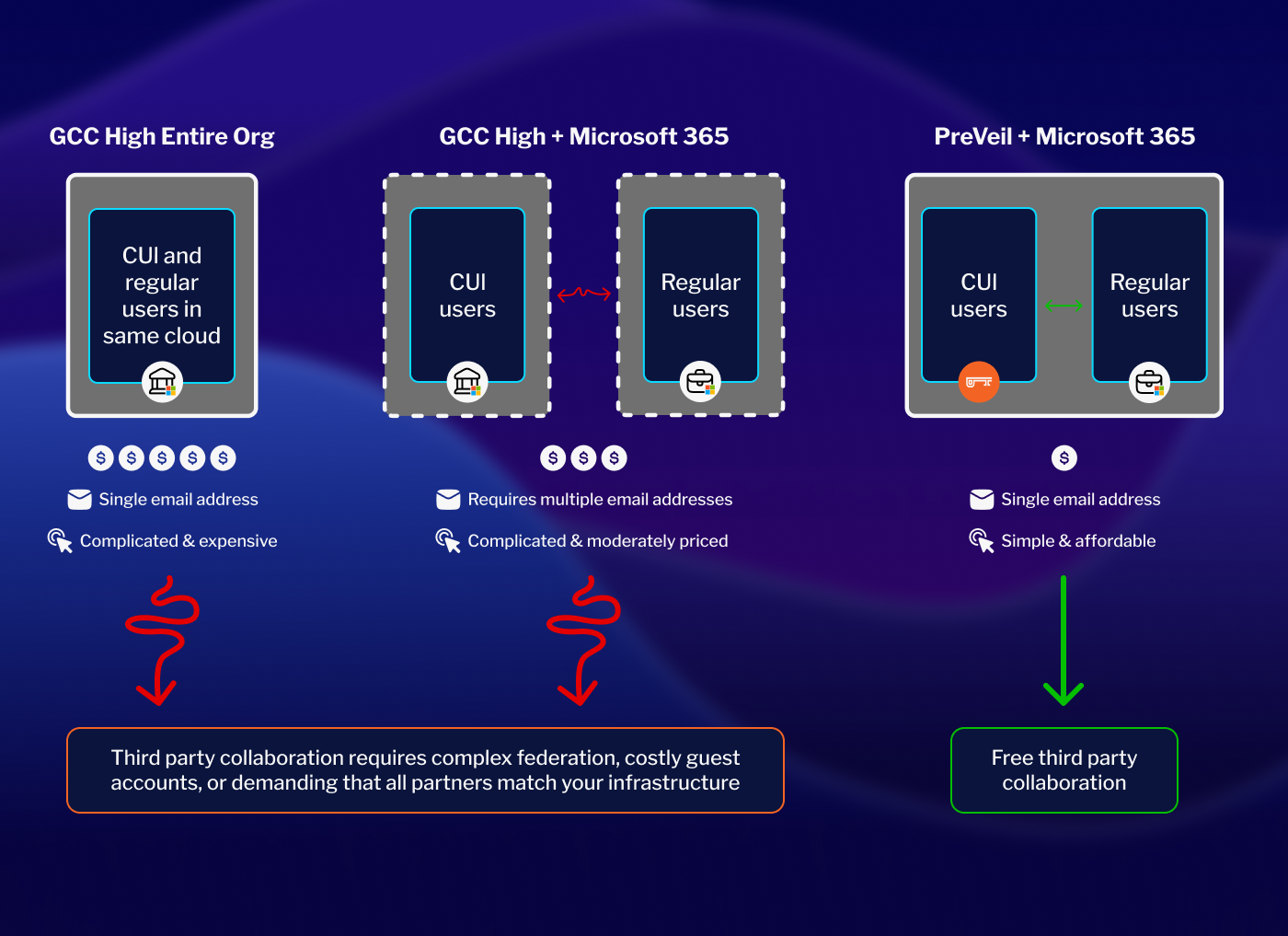
But in both GCC High scenarios, users run into real collaboration challenges and workflow disruptions, largely because a GCC High tenant is a pain to manage and does not easily interoperate with other environments. Even basic tasks like emailing or sharing CUI with suppliers and subcontractors become dramatically harder.
On the other hand, organizations that have deployed PreVeil know how a simple deployment model and fluid collaboration accelerates their path to CMMC. Let’s take a look at these options in detail.
The Legacy Solution: GCC High
Migrate Everyone into GCC High
Some organizations decide the cleanest approach is to move all users into GCC High, even if only a subset handle CUI. On the surface, this avoids the complexity of running two environments.
But even in this scenario, collaboration challenges don’t disappear.
GCC High is a separate Microsoft cloud with stricter controls about who you collaborate with. Many of your customers, suppliers, and partners won’t have GCC High. As a result, even basic workflows with 3rd parties — emails, meetings, file sharing, and Teams collaboration — require you to either:
- Create and manage GCC High guest accounts, which adds significant cost and IT overhead
- Hope that all external partners are also using GCC High, or
- Federate domains and create trust relationships — often complex and difficult to maintain
Federation means engineering a deep trust between two identity systems so they behave like one — it’s complex, fragile, and not tenable for many contractors. Even with Microsoft’s newer Business Premium offerings for GCC High, the reality remains the same: GCC High is optimized for isolated government workloads, not day-to-day collaboration with a commercial ecosystem.
Use GCC High as a CUI Enclave
Organizations can keep Microsoft 365 Commercial for everyday work and stand up GCC High as a dedicated enclave for CUI.
This approach introduces an entirely different set of challenges.
GCC High is not an extension of Commercial Microsoft 365. It requires a separate tenant, a new domain, and a separate identity stack. Users who handle CUI end up with two email addresses, two mailboxes, and two sets of credentials. Email becomes a liability: for example, GCC High provides no built-in warning when a user is about to send CUI to a non-compliant recipient or from the wrong mailbox. The burden is entirely on the user to catch mistakes before they happen.
From a compliance standpoint, a GCC High enclave can look neat on paper. In reality, it creates constant friction:
- Users must decide which identity to use for each task
- Meetings involving both environments must often be explicitly kept “out of scope” for CUI
- Email and file sharing across clouds becomes impossible without guest access or special provisioning
External collaboration becomes especially problematic. Subcontractors and partners in Commercial Microsoft 365 can’t collaborate on files in GCC High. Teams often resort to workarounds — emailing attachments, duplicating data, or avoiding collaboration altogether. These behaviors increase both security and compliance risks.
The Modern Alternative: PreVeil as a CUI Enclave
PreVeil was built to address these challenges by protecting CUI without requiring organizations to split their cloud or overhaul existing workflows. In a PreVeil deployment, CUI is isolated to PreVeil’s encrypted email and drive, ensuring sensitive data does not touch the commercial cloud. Users keep their primary email addresses and continue working with familiar tools such as Outlook and File Explorer. There is no cloud migration required, and administrators manage users, devices, and audit logs through a straightforward console.
The contrast is especially clear in external collaboration. PreVeil’s end-to-end encryption model keeps keys on user devices, so only intended participants can access CUI. Secure sharing does not depend on the recipient’s cloud environment or require paid guest accounts. Contractors can send encrypted email or file links directly to suppliers and subcontractors, who can create a free account if needed—enabling compliant collaboration across the supply chain without added complexity.
With over 75+ organizations having achieved CMMC compliance, PreVeil represents a proven and practical path to compliance. For organizations pursuing CMMC, this means fewer user mistakes, clearer system boundaries, faster time to compliance, and secure collaboration that works naturally with both internal teams and external partners.
Key Differences at a Glance
| Microsoft GCC High | PreVeil | |
| Best For | Large enterprises with dedicated IT, security, and compliance teams and the budget to operate a complex, isolated cloud. | Organizations of all sizes—especially SMBs—that need secure and seamless CUI handling without heavy IT overhead. |
| IT Overhead | Requires managing separate tenants, domains, identities, and complex cross-tenant access controls, increasing operational burden on IT teams. | No new tenant or identity stack required. Clear system boundaries with minimal administrative overhead and simple external collaboration. |
| User Experience | Users juggle multiple email addresses, follow manual CUI rules, and work around collaboration limits—making everyday tasks harder and spillage more likely. | Works within existing email and file tools. Users keep familiar workflows, reducing confusion and minimizing the risk of CUI mishandling. |
| Cost | Higher licensing costs, reseller markups, and added expenses for external collaboration and ongoing administration. | Lower total cost by avoiding additional licenses, reseller fees, and long-term IT management overhead. |
| Deployment | Requires a disruptive migration to a new cloud, often involving consultants and long transition timelines. | Deploys quickly within existing environments with no rip-and-replace or large-scale migration. |
| Security | Encrypts data in transit and at rest, but data remains accessible to the platform provider. | End-to-end encryption ensures only intended participants can access CUI—not even PreVeil. |
| 3rd party collaboration | Sharing CUI with suppliers and subcontractors is difficult and often requires guest accounts or workarounds that slow or prevent collaboration. | Free and secure sharing of CUI with external partners using their existing tools—no extra accounts or special provisioning required. |
Conclusion
Whether you move your entire organization into GCC High or use it as a CUI enclave, you introduce productivity challenges that can undermine both collaboration and compliance. When everyday actions like sending email or sharing files with suppliers become risky, slow, or confusing, compliance stops being a process and starts becoming a liability.
There is another way to protect CUI without splitting your cloud, fragmenting collaboration, or increasing operational risk. PreVeil is a proven solution that shows compliance and usability don’t have to be at odds.