A confidential email disclaimer is a notice at the top or bottom of a message saying it may contain privileged or confidential information and asking a mistaken recipient to delete it. It labels the message; it does not stop anyone from reading it.
What is a confidential email disclaimer?
A confidential email disclaimer (also called an email confidentiality notice) is a short statement added to outgoing email that identifies the message as confidential or privileged, tells an unintended recipient not to read, copy or forward it, and asks them to notify the sender and delete it. Law firms often add one automatically to every message.
Firms use disclaimers for three reasons: to flag privileged material, to set expectations for a recipient who receives a message by mistake, and to show that the firm treats client communications as confidential. ABA Formal Opinion 477R lists “Label Client Confidential Information” among the considerations it describes for protecting client communications, so labeling has a place. Labeling is one of several considerations in the opinion, and it does not protect the content by itself.
What should a law firm’s confidentiality notice say?
A law firm’s confidentiality notice should be short, plain and accurate. It should say the message may contain privileged or confidential information intended only for the named recipient, ask anyone else not to read, use or share it, and ask them to notify the sender and delete it.
Where the notice sits affects whether anyone reads it. A notice at the top of the message is more likely to be seen before the content is read, and a notice on every internal message loses meaning, so some firms apply it only to external mail.
Does a confidentiality disclaimer protect privilege or client data?
No. A confidentiality disclaimer does not prevent anyone from reading a message. It has no effect on the mail servers the message passes through, on a compromised mailbox, or on a recipient who ignores it. Whether a court treats a misdirected message as a waiver of privilege turns on the facts and local law, not on the footer.
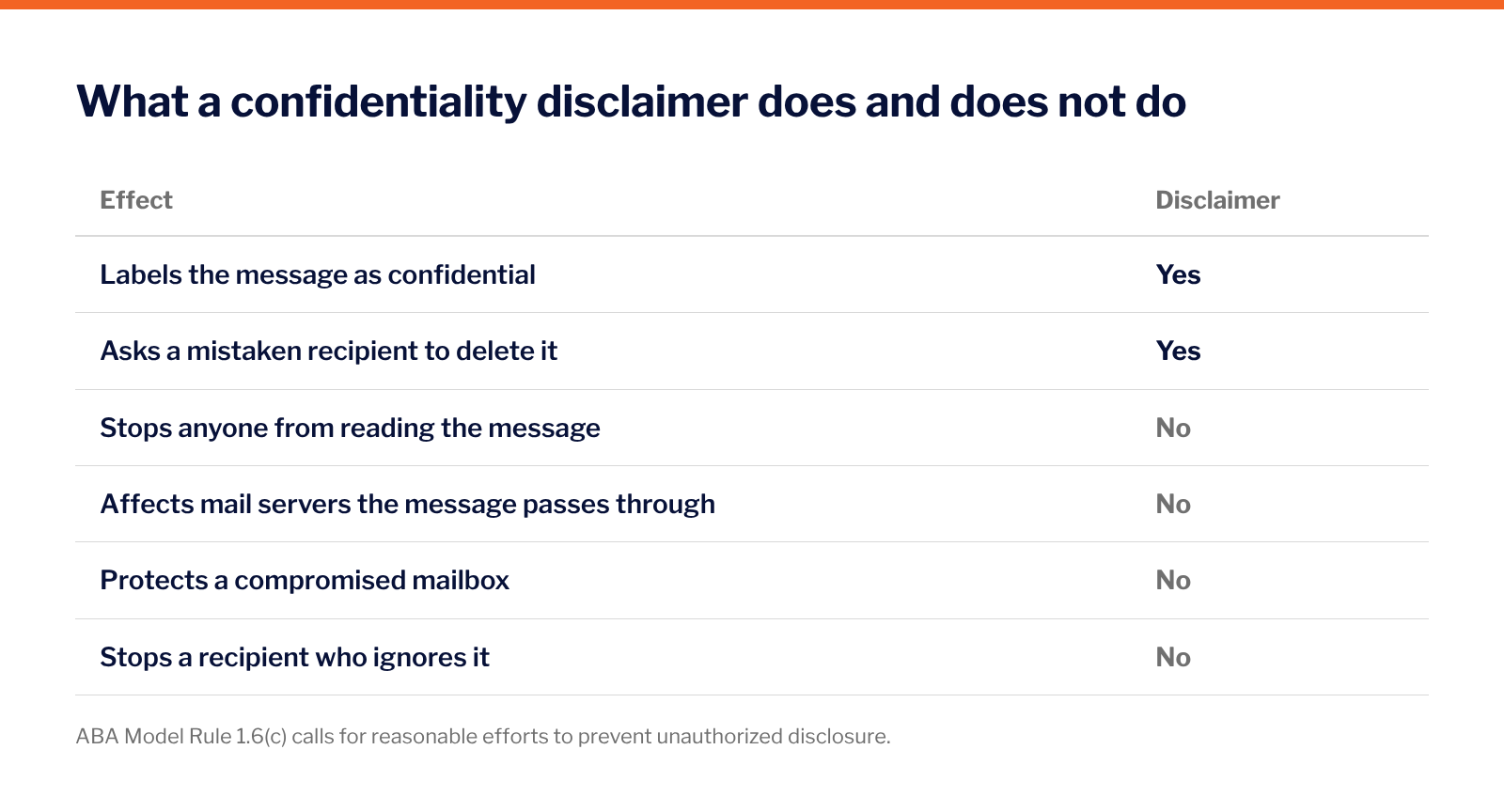
The data problem is technical. Standard email is readable by anyone with access to the mailbox or the provider’s servers where it is stored. If an attacker takes over a staff account, every message in it, disclaimer or not, is available to them. The ABA 2023 Cybersecurity TechReport found that 29% of respondents said their firm had experienced a security breach.
Model Rule 1.6(c) asks for more than a label. It requires a lawyer to “make reasonable efforts to prevent the inadvertent or unauthorized disclosure of, or unauthorized access to, information relating to the representation of a client.” A disclaimer addresses what a recipient should do after disclosure. Rule 1.6(c) is about preventing it.
What protects client data in email?
Encryption that keeps the message unreadable to anyone other than the sender and intended recipients protects client data in email. Access controls that stop an attacker from using a stolen password, and logs that show who accessed what, round it out. These are the controls clients ask about in HIPAA business associate agreements (BAAs), vendor policies and security questionnaires.
ABA Formal Opinion 477R puts it this way: “A fact-based analysis means that particularly strong protective measures, like encryption, are warranted in some circumstances.” Comment [18] to Rule 1.6 lists the factors for judging what is reasonable: “the sensitivity of the information, the likelihood of disclosure if additional safeguards are not employed, the cost of employing additional safeguards, the difficulty of implementing the safeguards, and the extent to which the safeguards adversely affect the lawyer’s ability to represent clients.”
For a firm with regulated clients, the client often decides the question. Opinion 477R says a lawyer “may be required to take special security precautions to protect against the inadvertent or unauthorized disclosure of client information when required by an agreement with the client or by law.” A healthcare client’s BAA, a financial services client’s vendor terms or a government contractor’s terms for handling controlled unclassified information (CUI) can be that agreement. PreVeil’s guide to law firm security obligations for regulated clients sets out each one.
How does a disclaimer compare with encryption?
A confidentiality disclaimer and email encryption do different jobs. A disclaimer tells an unintended recipient what to do after they receive a message. Encryption keeps the message unreadable to anyone without the key, including an attacker in a mailbox or on a provider’s servers. A disclaimer answers none of the security questions clients ask about email.
| Question | Confidentiality disclaimer | End-to-end encrypted email |
|---|---|---|
| Stops an unintended recipient from reading the message | No | Yes, without a key the content cannot be read |
| Protects messages in a compromised mailbox or on the provider’s servers | No | Yes, message contents and attachments stay encrypted |
| Addresses Rule 1.6(c) “reasonable efforts to prevent” disclosure | Labeling only | Supports it as a technical safeguard |
| Answers a client questionnaire’s encryption question | No | Yes, for email and files |
| HIPAA treatment when the work involves PHI | Not addressed | Encryption is addressable under 45 CFR 164.312(a)(2)(iv) and (e)(2)(ii), meaning the firm must assess whether it is reasonable and appropriate and document its decision |
A disclaimer is worth keeping because it costs nothing and signals the firm’s intent, but it is not a security control.
How does PreVeil protect client email?
PreVeil encrypts message contents and attachments end to end inside the Outlook, Gmail or Apple Mail a firm already uses. Keys are generated and held on each user’s device, so only the sender and recipients can decrypt a message. Clients read and reply for free from their browser, and their replies stay encrypted.
PreVeil cannot access or decrypt customer data, because the encryption keys stay on users’ devices. PreVeil uses FIPS 140-3 validated cryptographic modules, and includes an admin console with activity logs.
The PreVeil for law firms page covers the product for firms under 100 staff.
Frequently asked questions
Is a confidential email disclaimer legally binding?
A disclaimer generally does not create a binding obligation for a recipient who never agreed to it. Its value is as notice. Whether it matters in a privilege dispute depends on the facts and the jurisdiction.
Should the disclaimer go at the top or bottom of the email?
Put the disclaimer at the top if the goal is for a mistaken recipient to see it before reading. Many firms put it at the bottom for readability. Either way, a disclaimer does not protect the content.
Does a disclaimer satisfy ABA Model Rule 1.6(c)?
Not on its own. ABA Model Rule 1.6(c) asks for reasonable efforts to prevent unauthorized disclosure or access. ABA Formal Opinion 477R lists labeling as one consideration alongside security measures, training and vendor due diligence.
What should I use instead of a disclaimer?
Keep the disclaimer and add encryption that keeps message contents and attachments unreadable to anyone but the intended recipients, plus multi-factor access and activity logs.
Can PreVeil read my encrypted email?
No. PreVeil keeps encryption keys on users’ devices, so its servers cannot decrypt message contents or attachments.
Sources
- ABA Formal Opinion 477R: https://www.americanbar.org/content/dam/aba/administrative/professional_responsibility/ethics-opinions/aba-formal-opinion-477.pdf
- ABA, Employing competent and reasonable safeguards (Rule 1.6(c), Comment [18]): https://www.americanbar.org/groups/law_practice/resources/law-practice-today/2023-december/cybersecurity-for-attorneys-employing-competent-and-reasonable-safeguards/
- ABA 2023 Cybersecurity TechReport: https://www.americanbar.org/groups/law_practice/resources/tech-report/2023/2023-cybersecurity-techreport/
- 45 CFR 164.312: https://www.ecfr.gov/current/title-45/subtitle-A/subchapter-C/part-164/subpart-C/section-164.312
Talk to PreVeil about protecting client email
A demo shows how PreVeil encrypts client email inside the inbox your firm already uses. Request a demo