In today’s rapidly evolving digital landscape, the need for secure file-sharing has never been more critical. With cyber threats becoming increasingly sophisticated, businesses must adopt robust measures to protect sensitive information. In 2026, secure file-sharing isn’t just about convenience—it’s about safeguarding data, maintaining compliance, and preserving client trust.
This article explores the most effective ways to securely share files in 2026, why end-to-end encryption stands out as the best method, and how to use an end-to-end email encryption platform to protect your business communications.
In an era where data breaches and cyber attacks make daily headlines, secure file-sharing has become a cornerstone of business continuity and compliance. Organizations in regulated industries must go beyond basic security measures, as they face increasingly strict requirements under CMMC, NIST 800-171, ITAR, and HIPAA.
The stakes are particularly high for defense contractors, healthcare providers, and financial institutions, where a single data breach can result in severe penalties, lost contracts, and damaged reputations.
In 2026, secure file-sharing must address three critical challenges:
- protecting against sophisticated cyber threats
- maintaining rigorous compliance standards, and
- ensuring seamless collaboration with external partners.
This guide offers solutions that meet the highest security standards while simplifying the path to compliance and ensuring ease of use.
The Best Ways to Securely Share Files in 2026
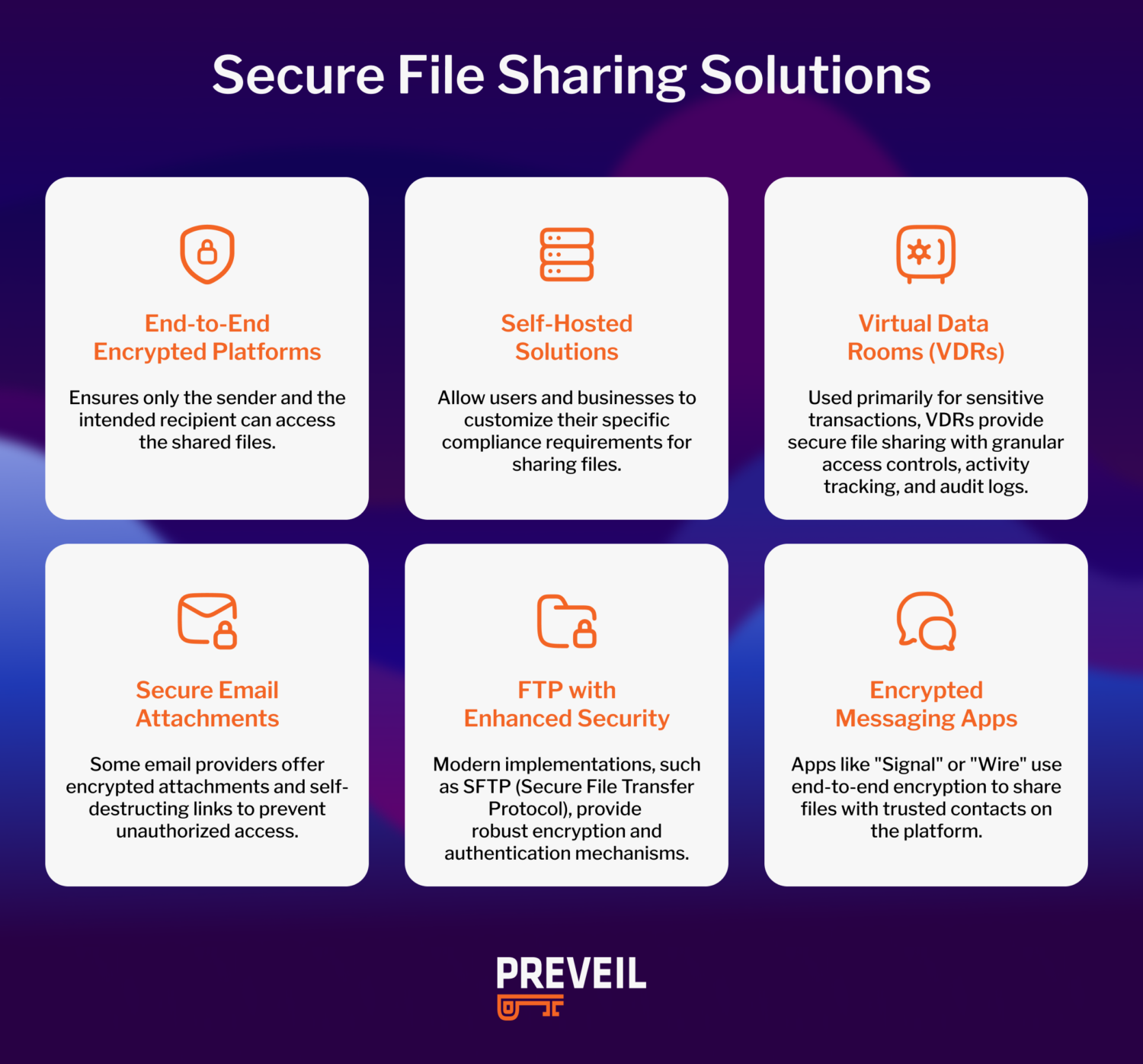
Secure file-sharing solutions have evolved to counteract advanced cyber threats. Here are the most reliable methods to securely share files in 2026:
1. End-to-End Encrypted Platforms
End-to-end encryption (E2EE) ensures that only the sender and the intended recipient can access the shared files. This means that even the service provider cannot view the data, making end-to-end encryption the most secure option. Modern platforms like PreVeil offer direct integrations with Gmail, Outlook, Mac Finder and Windows Explorer, and have their own stand-alone web app and mobile app, meaning you can access unrivaled security without compromising user experience.
2. Self-Hosted Solutions
Self-hosted solutions for sharing files allow for more customization and control over your data and privacy, allowing users and businesses to fit their specific compliance requirements for sharing files. The drawback of these solutions is that they are tedious and time-consuming to set-up and maintain.
3. Virtual Data Rooms (VDRs)
Used primarily for sensitive transactions like mergers and acquisitions, VDRs provide secure file sharing with granular access controls, activity tracking, and audit logs. In 2026, VDRs have adopted AI-driven threat detection and automated data classification to enhance security and efficiency, but can be more expensive than other solutions and more complex for those who aren’t as tech savvy.
4. Secure Email Attachments
Email remains a common method for sharing files, and many providers now offer encrypted attachments and self-destructing links to prevent unauthorized access. However, emails remain vulnerable to interception and there’s frequently an attachment size limit that prohibits many use cases.
5. File Transfer Protocol (FTP) with Enhanced Security
While FTP is an older method, modern implementations such as SFTP (Secure File Transfer Protocol) and FTPS (FTP Secure) provide robust encryption and authentication mechanisms, making them viable for secure file sharing. For this reason, if you decide to move forward with FTP, you may have to do extensive research to be sure you aren’t using an outdated implementation that won’t meet modern standards.
6. Encrypted Messaging Apps
Apps like Signal or Wire offer secure file sharing with end-to-end encryption, and are best when used for sharing smaller files with trusted contacts who already use the platforms. These messages can be set to auto-delete after a specified time as well, for an additional cost. It is important to note though that these apps are not built for enterprises and aren’t compliant.
Why End-to-End Encryption is the Best Way to Share a File
End-to-End Encryption is the cornerstone of secure file-sharing. Here’s why it remains the gold standard:
1. Data Confidentiality and Integrity
Encryption converts files into unreadable code that can only be decrypted with the correct key. This ensures that even if a file is intercepted, it cannot be accessed by unauthorized parties. In 2026, advanced encryption algorithms such as AES-256 and RSA-4096 are standard, offering virtually unbreakable security.
2. Compliance and Legal Requirements
With stringent data protection regulations such as GDPR, CMMC, CCPA, and the updated NIST Directive, businesses must implement secure file-sharing practices. Encryption addresses the data-protection requirement in most privacy and security frameworks, but it is one control among several those frameworks require.
3. Protection Against Cyber Attacks
Ransomware attacks, phishing, and data breaches are more prevalent than ever. Encryption provides a robust defense mechanism by rendering stolen data useless to attackers. Modern encryption methods also safeguard against man-in-the-middle attacks and spoofing.
4. Preserving Client Trust and Reputation
Data breaches can have devastating effects on a company’s reputation and customer trust. By implementing encryption, businesses demonstrate their commitment to data security, enhancing their credibility in the market.
How to Share Files Using an End-to-End Encryption Platform
End-to-end encryption platforms offer the highest level of security for file sharing. Here’s how to use them effectively:
Step 1: Choose an End-to-End Encryption Platform That Ensures Ease of Use
When selecting a platform, consider the following features:
- Deployment Time: Platform is easy to set up on your devices.
- Multi-Platform Compatibility: Supports sharing across devices and operating systems.
- User-Friendly Interface: Simplifies the sharing process without compromising security.
- Integration with Prominent Tools: Uses your existing email in popular platforms like Gmail and 0365 and works seamlessly alongside them.
PreVeil is an end-to-end encrypted email and file-sharing platform used by more than 100,000 users, with a free tier for email and file storage.
Step 2: Encrypt and Share the File
- Upload the File: Begin by uploading the file to the platform. If you chose a platform with the right integrations, this should look pretty similar to uploading a file to any other platform you use. The file is automatically encrypted before leaving your device, ensuring data security during transmission.
- Set Permissions: Define who can view, edit, or download the file. PreVeil allows setting expiration dates for access.
- Share Your File: Generate a secure, encrypted link or share the file directly through the platform’s messaging feature. Recipients will need decryption keys or secure authentication to access the file.
Step 3: Manage and Monitor Access
- Track Access: Monitor who accesses the file, when, and from which location. This helps detect unauthorized access attempts.
- Revoke Access: If needed, revoke access in real time to prevent further viewing or downloading. This is particularly useful for sensitive documents or time-bound projects.
Frequently Asked Questions about Securely Sharing Files
How secure is Dropbox for file sharing?
Dropbox offers strong security features such as encryption in transit and at rest, file recovery, and optional multi-factor authentication. However, it does not provide true end-to-end encryption by default, in which case Dropbox can access file contents.
How secure is sharing files on Google Drive?
Google Drive uses TLS encryption in transit and AES-256 encryption at rest. While it is secure for general business use, it is not end-to-end encrypted by default. This means Google retains control of encryption keys, which means they can access file contents + it does not meet strict compliance requirements like CMMC or ITAR without additional safeguards.
Is Microsoft Teams secure for file sharing?
Microsoft Teams is generally secure for file sharing within commercial organizations, as it leverages Microsoft 365’s security framework, including encryption, access controls, and compliance features. However it does not offer true end-to-end encryption meaning Microsoft servers are still vulnerable to cyberattacks. In order to comply with strict compliance requirements like CMMC, companies are required to upgrade to expensive systems like GCC High.
What are the risks of using unencrypted cloud storage platforms for sensitive file sharing?
Risks include:
- Lack of end-to-end encryption means your data is exposed to the company & on the servers, leaving them vulnerable to cyberattacks
- Misconfigured access permissions
- Insider threats or account compromise
- Third-party access to encryption keys
These risks are especially important for organizations handling regulated data such as CUI, PHI, or financial records.
How do companies monitor compliance in file sharing?
Companies monitor file-sharing compliance using a combination of:
- Audit logs to track who accessed or shared files
- Data loss prevention (DLP) tools to prevent sensitive data exposure
- User activity monitoring to detect unusual behavior
- Access controls and policy enforcement
Many organizations also integrate file-sharing platforms with SIEM systems to continuously monitor and respond to potential compliance violations.
What is data loss prevention (DLP) in file sharing?
Data loss prevention (DLP) refers to technologies and policies that detect and prevent sensitive data from being shared inappropriately. In file sharing, DLP tools can:
- Block unauthorized file transfers
- Flag sensitive content (e.g., SSNs, CUI)
- Enforce encryption or access policies
DLP is a critical component for organizations subject to compliance frameworks.
How do audit logs improve file sharing security and compliance?
Audit logs provide a detailed record of file activity, including who accessed, downloaded, or shared a file and when. This visibility helps organizations:
- Detect unauthorized access
- Investigate security incidents
- Demonstrate compliance during audits
Strong audit logging is often required for frameworks like CMMC and HIPAA.
What is the difference between encryption at rest and in transit?
Encryption in transit protects files while they are being transferred over the internet
Encryption at rest protects files while they are stored on servers
However, even when both are used together, files must be decrypted on the server to be processed — creating a window where data is exposed in plaintext. Anyone with server access (including the provider itself or an attacker who compromises the server) can potentially read the data during that window.
End-to-end encryption eliminates this gap. Files are encrypted on your device before they leave, and only the intended recipient can decrypt them. The server never has access to the keys — so even if it’s compromised, your data stays protected.
How do organizations securely share files with government agencies or contractors?
Organizations working with government entities typically use secure file-sharing solutions that:
- Meet compliance standards like CMMC or ITAR
- Provide end-to-end encryption or zero-trust architecture
- Enforce strict access controls and authentication
Popular solutions for sharing files within government agencies include:
- PreVeil, for small & medium sized defense contractors
- GCC High, for large teams who have the capacity and budget to do a full migration
- DoD Safe, for defense personnel sharing files too large for email.
Standard cloud storage tools alone are often insufficient without additional security layers.
What should you look for in a secure file sharing solution for compliance?
For compliance-driven environments, key features include:
- Support for regulatory frameworks (CMMC, HIPAA, GDPR)
- End-to-end encryption (or zero-knowledge encryption)
- Granular access controls and user authentication
- Audit logs and reporting capabilities
- Integration with identity and security tools
Can file sharing activity be tracked in real time?
Yes, many secure file-sharing platforms offer real-time monitoring and alerts. These capabilities allow organizations to:
- Detect suspicious downloads or sharing behavior
- Automatically revoke access if risks are identified
- Maintain continuous compliance visibility
Real-time tracking is especially valuable for preventing data breaches before they occur.
Conclusion
In today’s threat landscape, organizations need file-sharing solutions that combine uncompromising security with practical usability. PreVeil delivers military-grade, end-to-end encryption while allowing users to keep their existing email addresses and familiar tools. This seamless integration of security into everyday workflows makes it remarkably easy for teams to protect sensitive data without disrupting productivity.
For organizations in regulated industries, PreVeil’s proven solution also simplifies compliance with CMMC, ITAR, and other frameworks, offering a cost-effective way to meet security requirements while enabling secure collaboration across the enterprise.
Ready to Securely Share Files?
Ready to protect your sensitive data while keeping your familiar workflows? See how PreVeil deploys in minutes, integrates with your existing email, and enables secure collaboration—all with uncompromising end-to-end encryption. Book a demo today.