SBIR (Small Business Innovation Research) is a program created by the government to help small businesses develop products. If you’re reading this to decide whether to apply, this guide walks you through amounts, who’s eligible, where to look for opportunities, how to apply, common requirements, and practical tips to improve your chances.
What is SBIR Funding?
SBIR funding was established by the U.S. federal government to stimulate technological innovation and commercialization by small businesses, essentially helping these companies turn R&D into real-world products and businesses. SBIR, and the sister Small Business Technology Transfer (STTR) program, sets aside a portion of federal R&D budgets for competitive awards to U.S. small businesses. Awards are non-dilutive (you don’t give up equity) and are intended to help de-risk early technical work and bridge to commercialization. Each participating federal agency runs its program under the same overarching congressional statutes and SBA guidance, but each agency uses its own solicitations, topic lists, and review processes.
SBIR Funding Amounts
Award sizes and program phases vary by agency, but there are cross-agency guidelines and recent updates you should know.
SBIR Phases Explained
- SBIR Phase I: Feasibility and proof-of-concept work. Smaller, short duration award to test technical merit.
- SBIR Phase II: Full R&D to expand on Phase I results and build prototypes; larger award and longer period.
- SBIR Phase III: Commercialization stage; federal SBIR/STTR dollars do not directly fund Phase III (commercialization is expected to be achieved via private funding or government contracts), though agencies may procure products via acquisition vehicles.
SBIR Award Amounts
As of late 2024–2025, agencies were authorized to issue Phase I awards up to roughly $314,363 and Phase II awards up to $2,095,748 without separate SBA waivers; agency-specific program guidance often gives lower “typical” maxima. (These are policy/cap authority thresholds; most agencies set their Phase I/Phase II limits lower.)
SBIR Funded Projects
Here are some SBIR funding options by agency (illustrative, check the current solicitation for exact numbers):
- NIH (SEED): Phase I guidance commonly around ~$300k and Phase II up to ~$2M depending on the institute and topic; NIH budgets and number of deadlines are posted on SEED/NIH pages. (SEED)
- NSF (America’s Seed Fund): Phase I awards are commonly in the range of $300k and Phase II up to $1.25M (NSF raised amounts recently to strengthen support). (America’s Seed Fund)
- DoD, DOE, NASA, etc.: amounts vary by solicitation and mission; DoD phases sometimes include multiple release windows and contract vs grant mechanisms. Always read the agency solicitation. (Defense SBIR/STTR)
What this means for applicants: plan budgets conservatively, and don’t assume every agency will fund to the absolute cap. Write a clear, realistic budget that matches the stated topic goals.
SBIR Funding News
Two major developments in 2025 affected the SBIR landscape and should factor into any near-term planning:
- Program authority and appropriations timing (September–October 2025): SBIR/STTR program authority under statute lapsed on September 30, 2025, and a federal lapse in appropriations (a government shutdown starting October 1, 2025) caused program uncertainty, temporary delays to solicitations and award actions, and limited agency staffing. Agencies and SBA have published notices and advisories. If you have an active award or submitted proposal around this period, contact the agency program officer and monitor agency websites for updates.
- Agency-level timing and delays: Even before the 2025 lapse, agencies sometimes delay NOFO/BAA postings, award notifications, or start dates because of internal processes, appropriations timing, or program changes. Keep a close eye on official agency pages (NIH SEED, NSF Seed Fund, DOE, DoD, etc.) for “delayed” notices on specific solicitations. (U.S. DOE Office of Science)
Practical takeaway: SBIR funding continues to exist and agencies remain committed to the mission, but appropriations or reauthorization delays can postpone solicitations, reviews, or award starts. Always verify dates on the agency solicitation and contact program officers if timelines change.
SBIR Funding Opportunities
Here are some avenues small businesses can explore to obtain SBIR Funding.
Centralized and Agency Resources
- SBIR.gov — the program’s central portal that aggregates topics and agency links. Start here for cross-agency searches. (SBIR)
- NIH SEED (seed.nih.gov) — excellent for life-science/biotech SBIR/STTR opportunities, deadlines, and how-to materials. (SEED)
- NSF America’s Seed Fund (seedfund.nsf.gov) — for deep-tech, engineering, and broad scientific R&D solicitations. Use the NSF “Project Pitch” step if applicable. (America’s Seed Fund)
- Agency program pages — DoD, DOE, NASA, USDA, NOAA, etc., each maintain SBIR sections with topic lists and solicitation timelines. Example: DoD SBIR/STTR pages. (Defense SBIR/STTR)
Local & Intermediary Resources
- Small Business Development Centers (SBDCs), state SBIR assistance programs, and university tech transfer offices — provide proposal help and may run webinars or bootcamps. Many states have SBIR liaison programs that help connect applicants to resources. (sbdc.umkc.edu)
Strategy for Finding the Right SBIR Opportunity
- Start with topic alignment: search SBIR.gov by keywords and agency topics — ideal matches are narrowly targeted topics where the agency has a clear need.
- Talk to program officers early: many agencies encourage or require applicants to communicate with program staff — this can clarify fit and reduce wasted effort.
- Watch release windows: agencies often have recurring release cycles — know the deadlines and pre-submission requirements (For example, NSF’s Project Pitch).
SBIR Funding Requirements
Eligibility and compliance rules for SBIR funding are strict because these are federal awards. Acquiring SBIR funding means doing business with the U.S. Government, which comes with some strict compliance guidelines. If your business deals with government contracts and Controlled Unclassified Information (CUI), you may need to achieve CMMC compliance.
Here are the important requirements to know:
Core eligibility rules (high level)
- Applicant must be a U.S. small business concern (SBC): organized for profit, majority U.S. ownership (≥51% by U.S. citizens or permanent residents), and fewer than 500 employees (SBA regulations govern specifics). Different rules apply for STTR about partnership with a research institution. (SBIR)
Who Must Do the Work
- SBIR: the small business must perform a majority of the research (often >50% depending on phase and agency).
- STTR: requires a formal partnership with a nonprofit research institution (university, federally funded research lab) and a requirement for the research institution to perform a significant portion (typically 30%–60%) of the work. Check each agency’s STTR rules.
Administrative and Registrations
- Before submitting, you’ll typically need to register: SAM.gov, Grants.gov (for many agencies), DUNS/UEI, and agency-specific accounts (eRA Commons for NIH, NSF FastLane/Research.gov or NSF SBIR portal). Registration can take weeks, so start your application early.
Reporting, Deliverables, and Commercialization Expectations
- Federal awards include milestone reporting, financial audits, deliverables, and commercialization plans (especially for Phase II). Agencies look for credible routes to market (partners, customers, procurement plans). Phase II applicants often must submit a formal commercialization plan.
Demonstrate an Ability to Achieve Cybersecurity Compliance Requirements
- If you acquire SBIR funding, you’re going to need to meet the necessary government compliance requirements. Ensuring your data is encrypted and secure enough to meet CMMC compliance requirements, for example, is crucial. Companies like PreVeil can help your company achieve compliance with their affordable and easy-to-use solutions for email and file sharing.
How to Apply for SBIR Funding (Step-by-Step)
This is a compressed but practical checklist most SBIR funding applicants follow. Procedures vary by agency, so always follow the solicitation’s explicit instructions.
- Confirm eligibility and choose the right program (SBIR vs STTR). Read the agency eligibility pages and FAQ.
- Identify relevant topics/solicitations. Use SBIR.gov and agency topic pages; search by keywords and subtopics.
- Register early (SAM.gov, Grants.gov, DUNS/UEI, eRA Commons, etc.). Registrations can take 2–6 weeks if you’re new. You can start your application here, and the earlier, the better.
- Contact the program officer. Ask about fit, budget expectations, and any agency-specific advice. This can prevent wasted effort.
- Prepare a tailored proposal: follow the FOA/BAA instructions on formatting, page limits, and required attachments (resumes, budget, facilities, commercialization plan). Address the review criteria directly (innovation, technical approach, team, commercial potential).
- Submit before the deadline. Use the agency portal specified in the solicitation. Confirm submission and track any agency messaging.
- If funded: execute the project per the award, submit reports, and pursue commercialization and follow-on funding or contracts. If not funded, request reviewer comments (many agencies provide them) and revise for the next cycle.
How to Increase Your Chances of SBIR Funding
Companies seeking SBIR funding can take certain measures to increase their odds of receiving the assistance. For example,
- Match the topic exactly. The best proposals respond directly to an agency topic or solicitation. If your project is only tangential, your chance drops.
- Talk to program officers early and often. Their feedback can tell you whether your idea is in scope and how reviewers think.
- Show commercialization potential. Include evidence of market need, potential customers, letters of support, and a clear go-to-market plan. Phase II reviewers expect a commercialization roadmap.
- Budget realistically and explain costs. Reviewers check whether the requested funds match the scope and milestones.
- Build a strong team & partnerships. Demonstrated technical credibility and relevant business skills matter. For STTR, secure a university partner early.
- Use reviewers’ feedback. If you don’t get funded, revise based on critiques — many successful applicants win on their 2nd or 3rd submission.
- Leverage local resources. SBDCs, state SBIR programs, and university tech transfer offices often run proposal clinics and mock reviews.
- Improve Security. Companies that prioritize security to meet compliance requirements like CMMC will have a leg up on the competition.
SBIR Funding FAQs
Is SBIR Funding Delayed?
Possibly, timing depends on agency appropriations and program authorization. In 2025 the SBIR/STTR statutory authority lapsed (September 30, 2025) and a lapse in appropriations began October 1, 2025, which temporarily impacted solicitations, award notifications, and staffing at some agencies. Agencies issued notices explaining that solicitations or award start dates might be delayed; however, many agencies intend to resume normal operations once appropriations/reauthorization issues are resolved. If you have an active application or award, contact the program officer and monitor the agency SBIR page for status updates.
How do I increase my chances of SBIR funding?
See the “Practical tips” section above. Short version: pick the right topic, talk to program officers, present a strong technical team, build a credible commercialization plan, and respond directly to the review criteria. Use local help (SBDC, state programs) and iterate with reviewer feedback.
What’s the difference between SBIR and STTR?
SBIR requires the small business to perform the majority of the work; STTR requires a formal collaboration with a nonprofit research institution and mandates a defined portion of the work be performed by that partner. STTR is specifically designed to transfer technology from research institutions to small businesses. Check agency STTR rules for exact percentages.
How long does the SBIR funding process take?
From proposal submission to award can range from a few months to 9+ months depending on the agency and solicitation cycle. Phase I is typically 6–18 months; Phase II often 1–3 years. Expect additional time for registrations and agency review.
Are SBIR awards grants or contracts?
They can be grants, contracts, or other transactions/agreements depending on the agency and solicitation type (For example, NIH typically uses grants; DoD often uses contracts). Contract awards may have different requirements and reporting. Always read the solicitation. (Defense SBIR/STTR)
Can I have venture capital and still apply?
Yes, but there are additional ownership and eligibility rules if you are venture-backed. Certain SBA rules and agency policies govern venture capital ownership and control; large VC ownership may change eligibility or routing. Check the SBA eligibility guide and agency FAQ before applying.
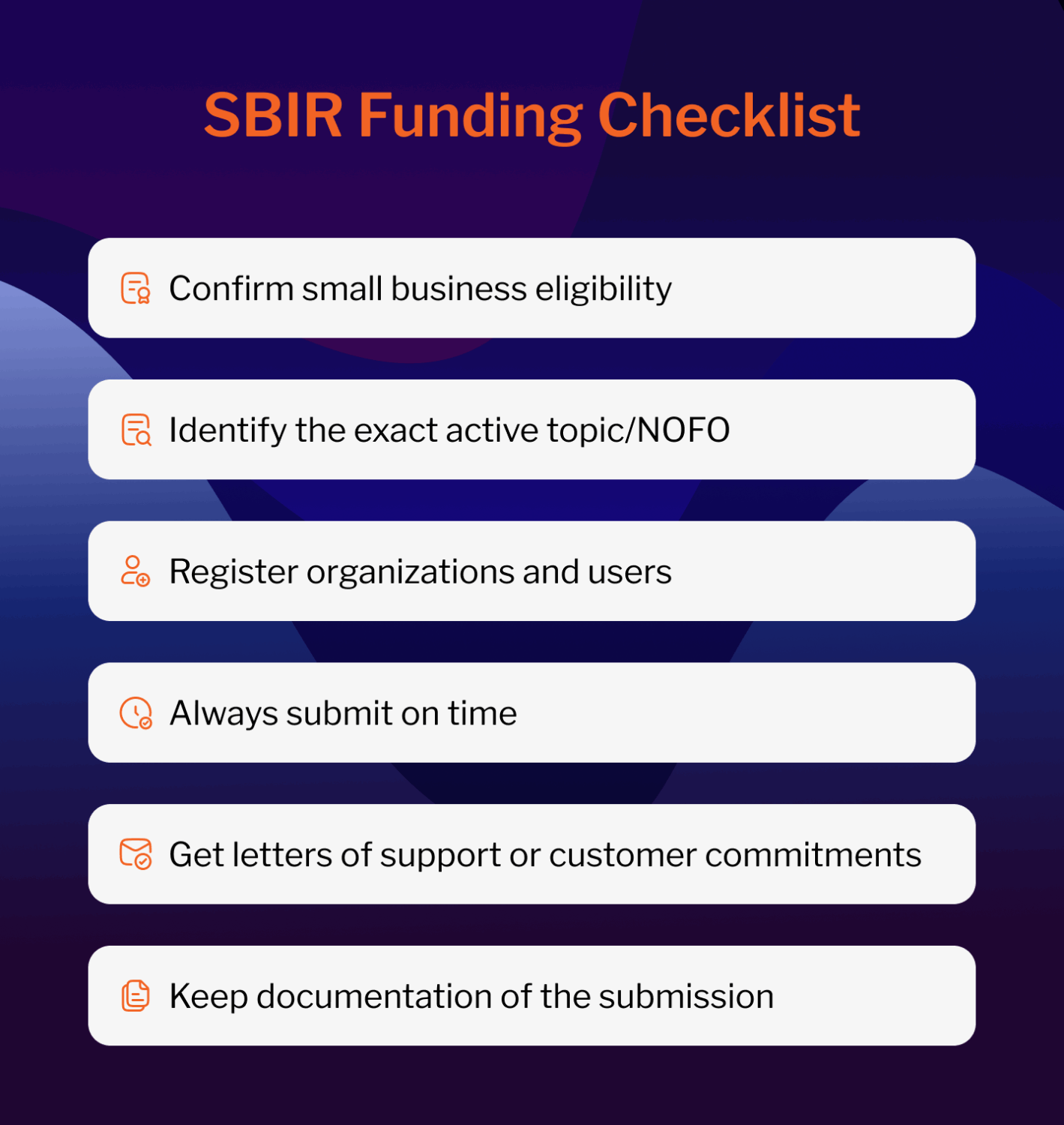
SBIR Funding Checklist
- Confirm small business eligibility (ownership, size).
- Identify the exact active topic/NOFO and read it top-to-bottom.
- Register organizations and users (start this early).
- Talk to the program officer and get clarity on fit.
- Build a realistic budget and commercialization plan.
- Get letters of support or customer commitments where applicable.
- Submit on time and keep documentation of the submission.
Follow this checklist or refer to the helpful infographic below to make sure you are taking the necessary actions to receive SBIR funding.
Is SBIR Right for Your Business?
If your small business needs non-dilutive capital to de-risk R&D, and your technology aligns with a federal agency’s mission, SBIR funding can be transformative by bringing funds, credibility, and commercialization support. However, it requires patience, the ability to meet compliance measures, and close alignment to topic requirements. Use the resources above, talk to program officers, and plan timelines assuming possible agency delays or reauthorization issues. With careful prep and a commercial orientation, SBIR funding can be a cornerstone of systematic growth and technology validation.